

Importing Iranian Rose Water in 2026: The Complete B2B Buyer's Guide

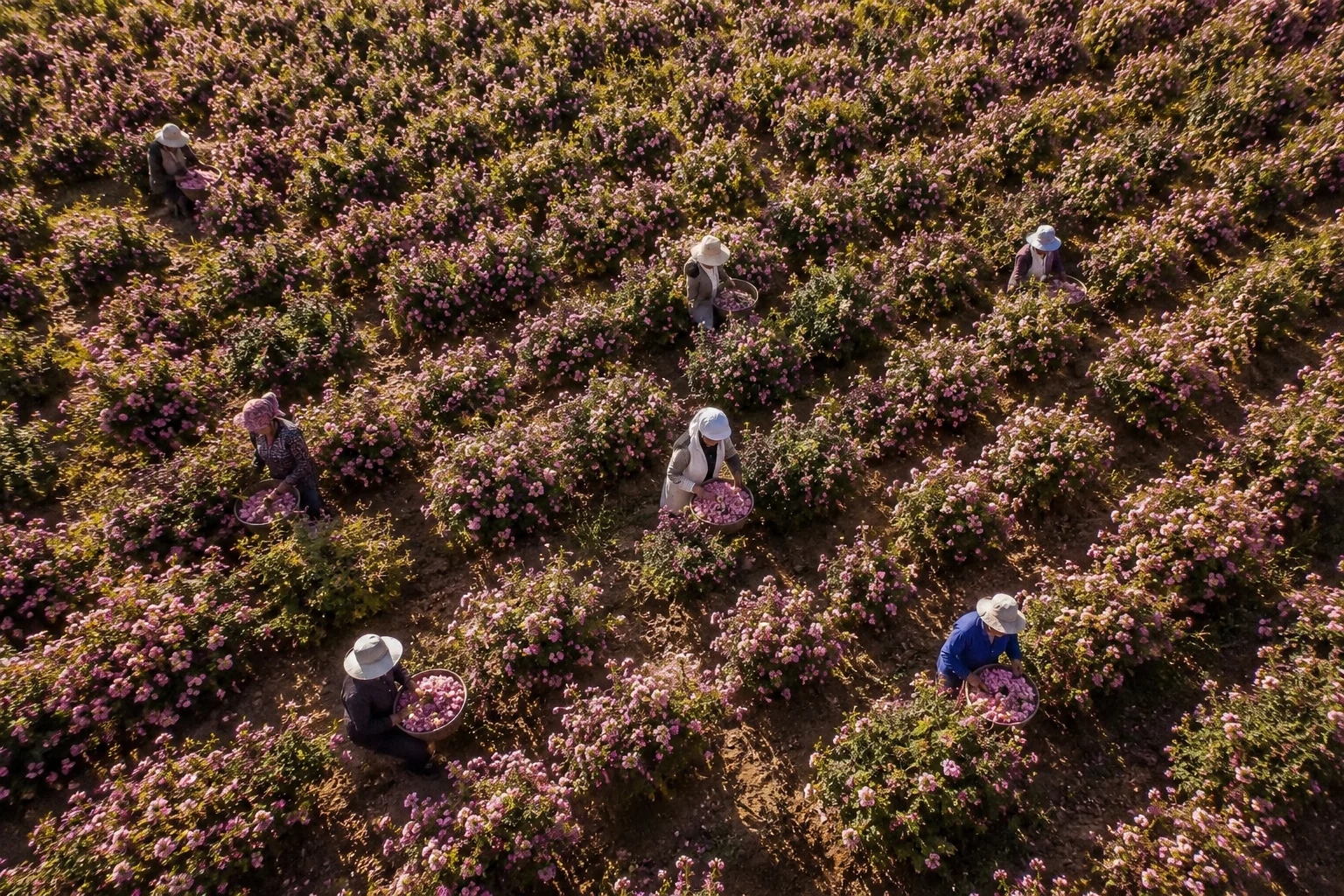
worker picking in a damask roses farm in iran

Importing Iranian Rose Water in 2026: The Complete B2B Buyer's Guide

worker picking in a damask roses farm in iran

Sourcing rose water for wholesale distribution, private label, or manufacturing input means navigating a supply chain that looks nothing like sourcing a standardized commodity. Rose water is agricultural, seasonal, easy to dilute without visual detection, and inconsistently classified across customs regimes. This guide is built for the buyer’s side of that equation: what to specify, what to verify, what documentation to request, and where deals with Iranian suppliers typically go wrong.

Why Iran Produces the World's Most Famous Rose Water

Iran’s rose water production traces back over a thousand years, with distillation methods documented as far back as the physician-scientist Avicenna, and commercial distilleries recorded operating in Shiraz as early as the seventeenth century. That history matters less as a marketing point and more because it explains why Iran’s rose water infrastructure — from cultivar selection to distillery design — is more mature and specialized than in most producing countries.

That maturity shows up in trade volume. According to Iran’s National Union of Rose Water and Herbal Distillates Producers, Iranian rose water reaches roughly thirty export markets, led by Saudi Arabia, the UAE, and Bahrain. The UAE plays an outsized role in this trade as a re-export hub: it imports Iranian rose water in bulk, repackages it, and re-exports it onward to other markets, which is part of why UAE trade statistics for rose water don’t reflect true end-market consumption. Demand outside the Gulf has also been expanding, with China and South Korea importing increasing volumes for spa and wellness applications, and Germany importing for food industry use.

For a buyer evaluating Iran as a source, the practical takeaway is that Iranian producers are set up for export at scale, with established documentation processes and freight routes — this is not a market where you’re the first international buyer a distillery has worked with.

What Makes Iranian Rose Water Different

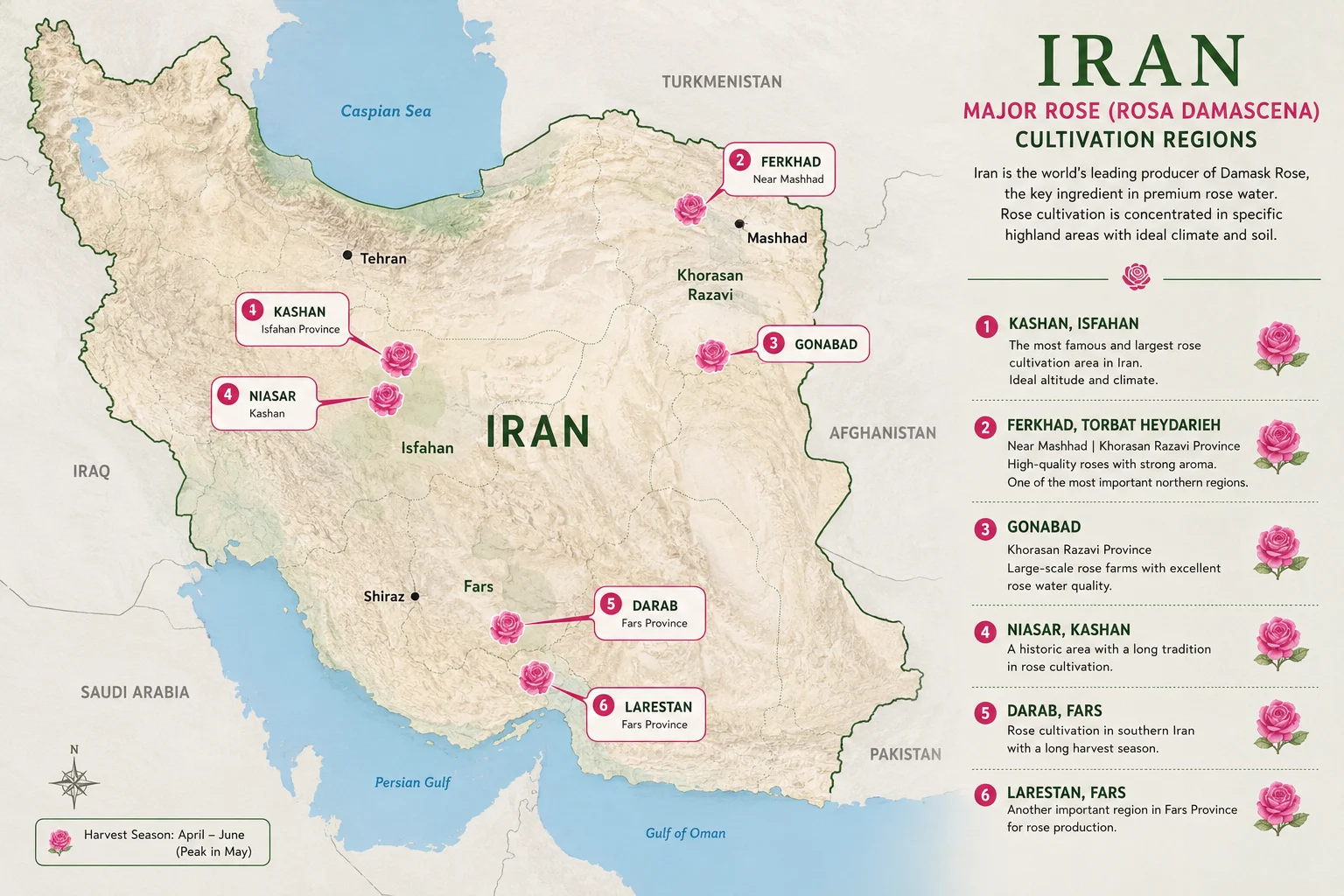
Iranian rose water is not produced in one uniform location. Two regions account for the large majority of commercial-grade output, and they aren’t identical products.

Qamsar, in Kashan County, Isfahan Province, is the historic center of the industry and remains where the largest volume of commercial distillation happens. Industry estimates place Kashan’s annual output in the range of 30,000 to 33,000 tons of rose water, with field yields of roughly two to seven tons of rose petals per hectare depending on seasonal conditions.

Farrokhad, in Khorasan, has grown into a significant secondary production region. Khorasan’s climate differs meaningfully from Isfahan Province — cooler nights and a slightly later bloom window — and producers in the region generally describe Farrokhad rose water as having a somewhat different aromatic character than Qamsar’s, though both come from the same Damask rose species. For a buyer, sourcing across both regions is a practical way to diversify supply risk: a weak harvest year in one province doesn’t automatically mean a weak year in the other, which matters for anyone locking in annual volume commitments.
It’s also worth being precise about what “Damask rose” does and doesn’t guarantee. Rosa damascena is the same species grown in Bulgaria’s Rose Valley and in Turkey for the global perfumery trade, but climate, soil, and distillation practice produce distinctly different aroma profiles between Iranian, Bulgarian, and Turkish output. Species alone is not a quality claim — it’s a starting point that still needs to be backed by lab verification.

Global Rose Water Market Overview

Market research estimates for the global rose water market cluster in a fairly consistent range: roughly $475 to $540 million in current value, with most forecasts projecting growth to somewhere between $970 million and just over $1 billion by the early 2030s, at a compound annual growth rate around 7%. Buyers should treat any single figure in this space with some caution — market research vendors disagree with each other by wide margins on the broader “floral water” category that includes other hydrosols, with estimates for that larger category ranging anywhere from roughly $2.5 billion to $20 billion depending on the research firm and how they define the category. Directionally, the signal is consistent growth driven by clean-label cosmetics demand and food and beverage use; the exact market-cap figure is less reliable than the trend itself.

On the European side, the European Commission-regulated cosmetics and natural ingredients market that rose water competes and travels alongside is described by CBI, the Netherlands-based trade promotion body for exporters from developing countries, as a market where demand for essential oils and natural distillates is expected to roughly double over a six-year horizon, driven largely by clean-label demand in cosmetics. The top importing countries for essential oils and related natural distillates into Europe are France, Germany, the UK, the Netherlands, Switzerland, and Spain — with the Netherlands and Switzerland functioning primarily as trading and distribution hubs rather than end-consumption markets, similar in structure to the UAE’s role in the Gulf.

Types of Rose Water

Type Process Aroma Profile Typical Use
Single-distilled Direct byproduct of one steam distillation pass Full-bodied, characteristic rose aroma Food, beverage, mainstream cosmetics
Double-distilled Redistilled a second time Lighter, more refined, less residual plant material Premium cosmetic formulations
Compound/blended Rose water combined with other botanicals or additives Varies by formulation Custom OEM products, specialty retail

There’s also a terminology point worth clarifying before writing a purchase order: “rose water” and “rose hydrosol” are used interchangeably throughout most of the trade to describe the same aqueous distillate. Where a distinction is drawn, “hydrosol” tends to signal a product marketed toward cosmetic or aromatherapy buyers as a minimally processed distillate, while “rose water” is used more broadly across food and general commercial contexts. This is a marketing convention rather than a regulated technical distinction, so neither term on its own guarantees a specific concentration — that has to come from a Certificate of Analysis.

Food Grade vs Cosmetic Grade

Primary concern Additive-free composition, ingestible safety Aroma refinement, dermal safety
Common distillation Single-distilled Often double-distilled
Core certification HACCP or ISO 22000 Safety Data Sheet, REACH (EU-bound)
Regulatory anchor National food safety codes EU Regulation (EC) 1223/2009 (if EU-bound)
Typical buyer Food & beverage manufacturers, importers Cosmetics brands, formulators

The distinction isn’t primarily about the distillation process — it’s about documentation, additive tolerance, and testing focus. Additives like glycerin or synthetic fragrance, even in small amounts, are typically disqualifying for food-grade use unless explicitly disclosed and permitted under the destination market’s food regulations. Cosmetic-grade shipments into the EU specifically need to align with Regulation (EC) 1223/2009 on cosmetic products, Regulation (EC) 1907/2006 (REACH), and Regulation (EC) 1272/2008 (CLP) for the raw ingredient itself. These aren’t Iran-specific requirements; they apply to any natural ingredient entering the EU cosmetics supply chain, but they’re frequently the point where first-time Iranian-supplier relationships stall, simply because the requirement isn’t raised until late in the process.

How Rose Water Is Produced

Iranian producers use both traditional and industrial steam distillation methods, and the difference matters for consistency, not just scale. In traditional operations, petals are boiled directly in the still together with water. In industrial distilleries, steam is passed through the petals rather than boiling them directly — a gentler process generally considered better at preserving the more volatile aromatic compounds. Buyers sourcing for premium cosmetic applications should specifically ask which method a given supplier uses, since it affects both aroma quality and batch-to-batch consistency.

Damask Rose Harvest
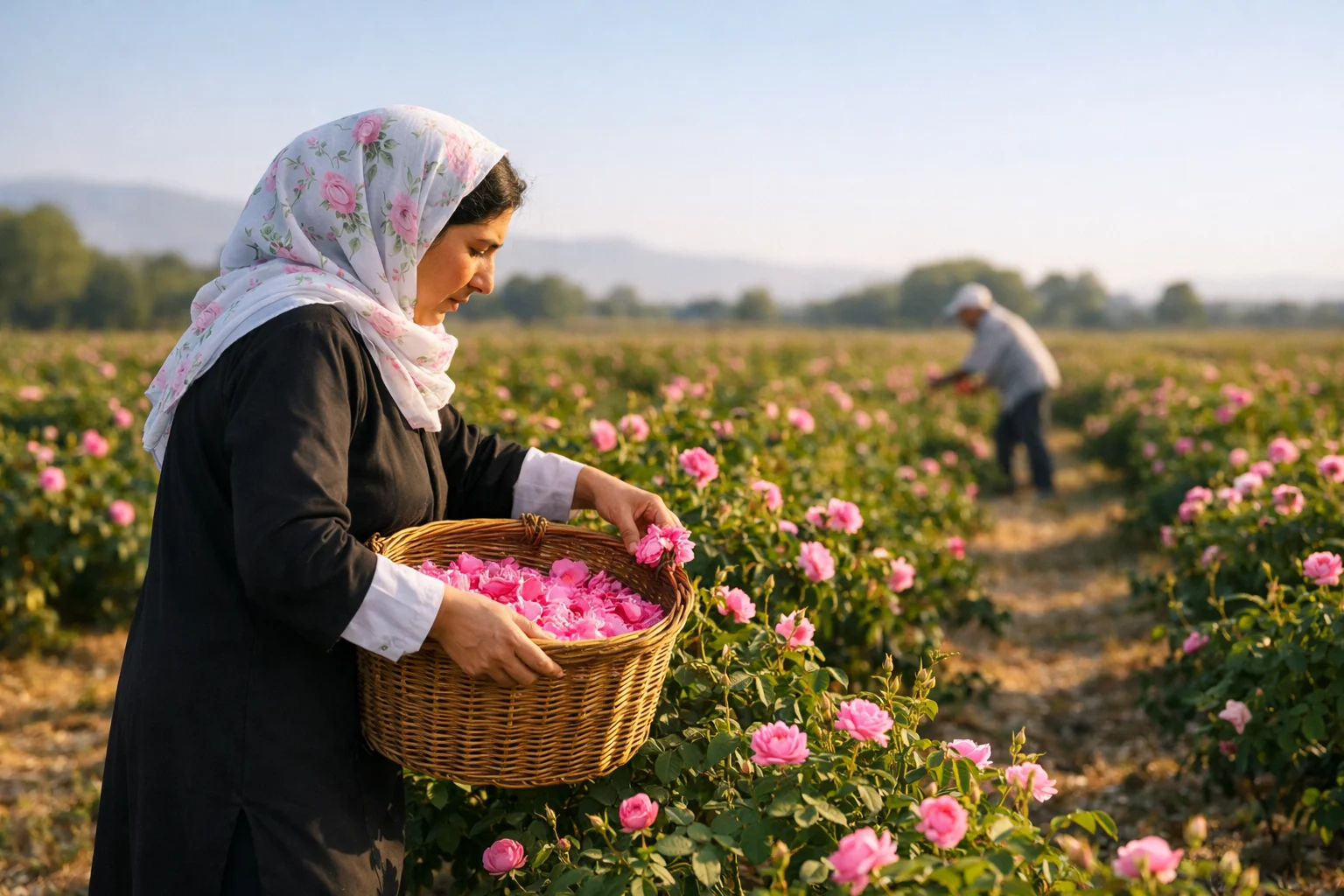
a woman worker picking damasc rose in a iranian farm

Rose harvest in Iran runs for a short window each spring, and timing within that window is one of the biggest levers on final product quality. Picking is done in the early morning hours, while petals still hold their highest concentration of aromatic compounds, before the day’s heat begins degrading them. Petals that sit too long after picking before reaching the still lose aromatic quality to microbial activity, which is why serious producers move petals from field to still within hours, not days.

For a buyer, this narrow window is the reason rose water supply is fundamentally seasonal rather than continuous. Annual contracts should be structured around a single harvest period, and buyers negotiating volume commitments are generally better served locking in pricing shortly after harvest, while supply is at its fullest, rather than waiting until later in the year when available stock — and negotiating leverage — both narrow.

Distillation Process and Yield

A commonly cited figure for the traditional Iranian process is a yield of roughly two to three kilograms of rose water for every kilogram of fresh petals used. Combined with field yields of two to seven tons of petals per hectare, this ratio is what ultimately sets the ceiling on how much verified, high-quality rose water is available in a given year — worth understanding before negotiating long-term volume commitments with any single supplier.
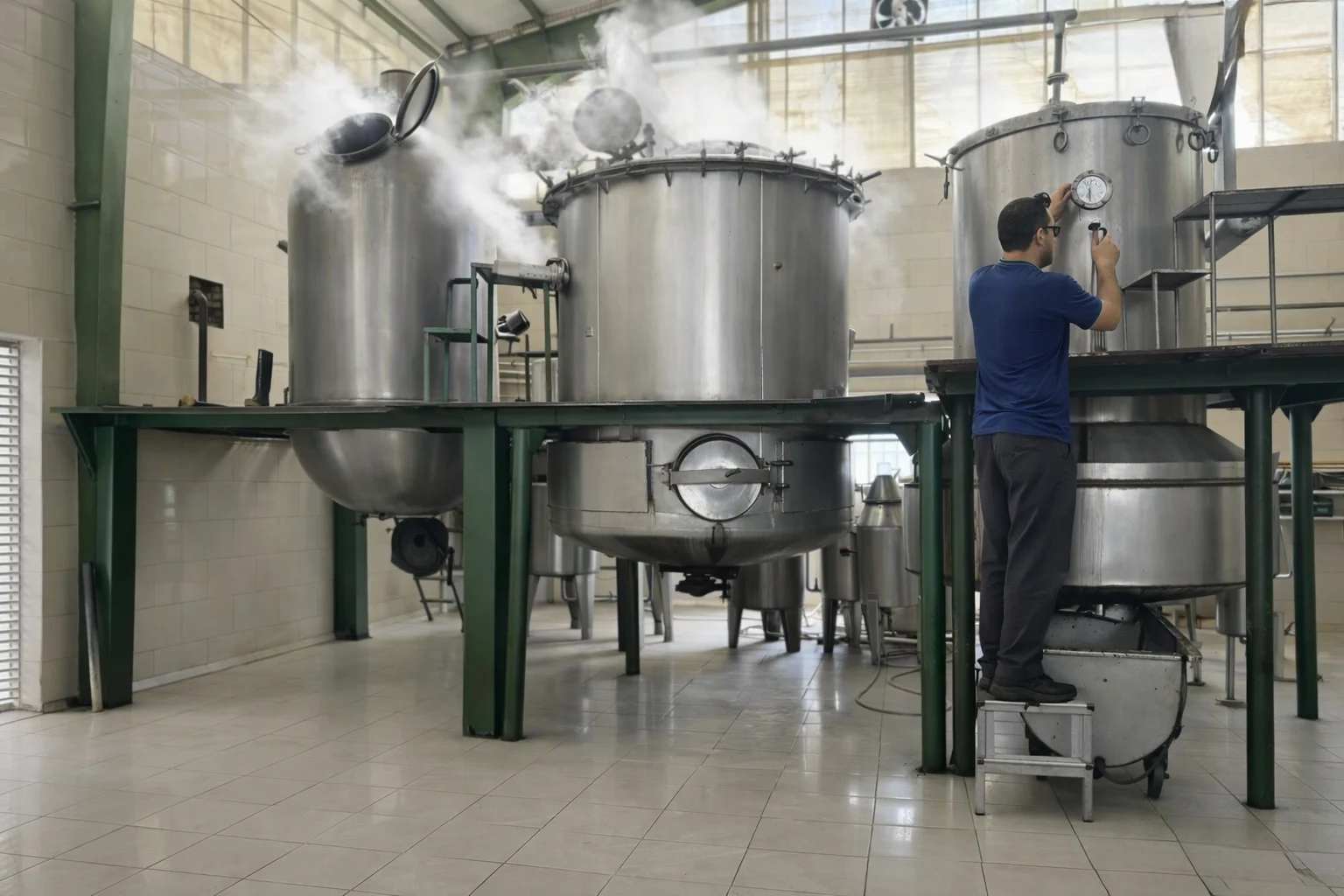
A rose water production line operator adjusts the pressure of distillation boilers at a rose water factory in Iran.
Distillation Comparison Traditional (Direct Boil) Industrial (Steam-Passed)
Method Petals boiled directly with water Steam passed through petals
Aromatic compound preservation Moderate Generally higher
Scale Smaller batches Larger, more consistent batches
Typical buyer fit Artisanal / small private label Bulk wholesale, larger private label runs

Chemical Composition

Genuine Damask rose water’s aromatic character comes from a specific set of volatile compounds — primarily citronellol, geraniol, and phenylethanol, along with smaller quantities of nerol and other terpene alcohols. These compounds are what gas chromatography-mass spectrometry (GC-MS) analysis looks for when verifying authenticity: a genuine distillate shows a consistent, recognizable compound profile, while a diluted or synthetically enhanced product typically shows an off-profile that a qualified lab can flag even when the product smells convincing to a non-specialist.

Beyond aromatic compounds, two simpler and faster tests give buyers a practical first screen: pH, which falls within a narrow, testable range for genuine Damask rose water and is one of the fastest ways to flag dilution, and Total Dissolved Solids (TDS), which reflects concentration and helps catch inconsistency between batches from the same supplier. Rose water is, by composition, over 99% water, with a density close to 0.99–1.00 g/mL — close enough to plain water that weight-based freight calculations should use this figure rather than assuming a lighter aromatic liquid.

Quality Standards

It’s worth being direct about a gap in this industry: there is no ISO standard written specifically for rose water. The relevant ISO document, ISO 9842, covers rose oil — the essential oil, not the aqueous distillate — and even that standard, in its current 2024 edition, specifies characteristics for rose oil cultivated in Turkey, Morocco, and Bulgaria specifically. It does not cover Iranian-origin rose oil or rose water at all.

Standard / Body What It Covers Relevance to Rose Water
ISO 9842:2024 Rose oil (Turkey, Morocco, Bulgaria) Adjacent, not directly applicable to Iranian rose water
EU Regulation (EC) 1223/2009 Cosmetic products placed on the EU market Applies if rose water is sold into EU cosmetic channels
EU Regulation (EC) 1907/2006 (REACH) Chemical/ingredient registration in the EU Applies to the raw ingredient for EU-bound shipments
EU Regulation (EC) 1272/2008 (CLP) Classification, labelling, packaging Applies to EU-bound shipments
HACCP / ISO 22000 Food safety management at the production facility Expected by most food-grade buyers

In practice, this means quality assurance in the Iranian rose water trade runs almost entirely on the strength of each individual supplier’s Certificate of Analysis and their willingness to submit to independent lab testing, rather than on a universal published standard a buyer can simply cite in a contract. That makes supplier vetting more important in this category than in commodities where an ISO or Codex standard does the verification work for you — worth noting that Codex Alimentarius, the body that does set international food standards, does not currently maintain a rose water-specific standard either, leaving general food safety codes (like HACCP) as the applicable framework instead.

International Certifications

Certification / Document Who Typically Requires It
Certificate of Analysis (batch-specific) All serious buyers
Phytosanitary certificate Most import jurisdictions, agricultural-derived goods
Halal certification Middle East, North Africa, Southeast Asia resale channels
HACCP / ISO 22000 Food & beverage buyers
Certificate of Origin Customs clearance in most markets
Safety Data Sheet Cosmetic and industrial buyers
REACH / CLP documentation EU-bound cosmetic shipments

Ask early in supplier conversations which of these are issued as standard practice versus which require advance notice — this directly affects lead-time planning on a first order.

HS Code and Customs Classification

Rose water’s customs classification is one of the more commonly misunderstood details in this trade, because it isn’t classified identically everywhere. In the United States, a formal Customs and Border Protection ruling classified bottled rose water under HTSUS 3301.90 — the “aqueous distillates and aqueous solutions of essential oils” subheading — rather than under perfumes. In India, by contrast, rose water is classified under HS 3303, within the perfumes and toilet waters heading. This distinction affects duty rates and documentation requirements for what is physically the same product, so buyers should confirm the correct classification with their own customs broker for their specific destination market rather than assuming a single global code applies.

Export Requirements

Shipments into the EU need to satisfy REACH and CLP requirements at the ingredient level if they’re destined for cosmetic use, in addition to standard food-safety documentation if destined for food use — these are EU-wide requirements, not Iran-specific hurdles, but they’re commonly where a first shipment gets delayed simply because the paperwork wasn’t requested from the supplier early enough. Packaging for international shipment should meet UN-standard specifications for drums and jerry cans used in cross-border trade, which most established Iranian exporters already default to, but it’s worth confirming rather than assuming on a first order.

Packaging Options
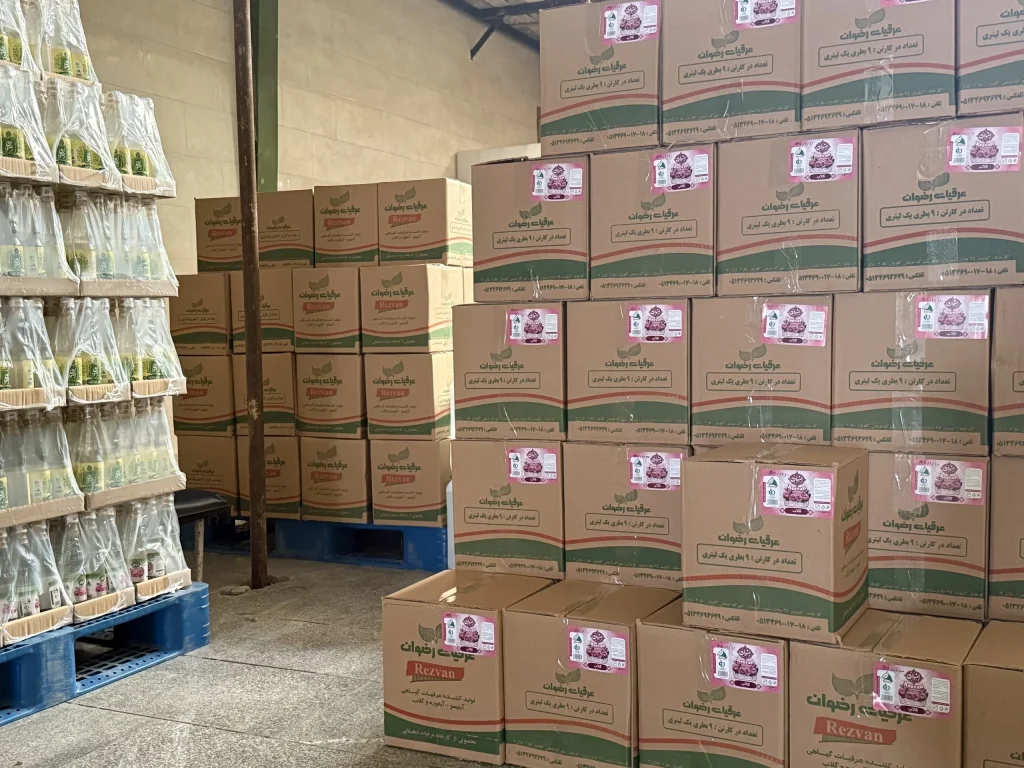
Rose water cartons in custom packaging in the warehouse of a rose water factory
Format Volume Best For Approx. Weight (Full)
Food-grade drum 25 L Small trial orders, sampling ~25 kg
Food-grade drum 200 L Standard wholesale orders ~200 kg
IBC tote 1,000 L High-volume, recurring contracts ~1,000 kg
Glass bottle 250 ml – 1 L Finished, retail-ready / private label Varies by format

Buyers should confirm that drum or tote linings are food-grade and chemically compatible with rose water for the full duration of shipping, and that packaging meets UN-standard specifications where required by the destination market. Suppliers offering direct private-label bottling can meaningfully reduce a buyer’s own repackaging logistics.

Shelf Life

Properly distilled and packaged rose water typically holds for eighteen to twenty-four months. The main variables affecting that window are the concentration and purity of the batch, whether any preservative was used, and how consistently it was kept below temperature thresholds that accelerate aroma degradation during both storage and transit. Buyers should ask suppliers for the expected shelf life of the specific batch being purchased, not a generic industry figure, since concentration and preservative use both shift the number meaningfully.

Storage Conditions

Rose water should be kept cool, dark, and away from temperature fluctuation. As a general guideline, standard storage in the range of 15–25°C (59–77°F) supports the typical 18–24 month shelf life, while refrigerated storage around 4–10°C is commonly recommended by hydrosol producers for buyers looking to extend freshness beyond that standard window. Direct sunlight and heat cycling are the two most common causes of premature aroma loss, and both are more of a risk during shipping and warehousing than during final retail storage. Buyers importing into regions with long inland transit after the port of arrival should ask specifically about temperature exposure during that leg, not just the sea voyage.

Choosing a Reliable Supplier

A reliable supplier should be able to provide, without hesitation: a batch-specific Certificate of Analysis and a willingness to accommodate independent third-party lab testing; clear, specific answers about distillation method and concentration ratio rather than vague marketing language; sample availability before any bulk commitment; a documented export history and, where reasonable, references from prior buyers; and transparent packaging and Incoterm options rather than a single take-it-or-leave-it format.

Vague answers, resistance to third-party verification, or pressure to skip sampling are the clearest warning signs in this trade. Given that no universal ISO or Codex standard governs rose water quality, supplier-level verification is effectively the industry’s real quality control mechanism — treat it accordingly rather than as an optional extra step.

Private Label Opportunities

Many established Iranian rose water exporters offer private-label bottling — supplying rose water under a buyer’s own brand and packaging rather than in generic bulk drums. This suits buyers who already have a defined product concept and want to launch under their own brand without managing a separate repackaging step. Minimum order quantities for private-label runs are typically higher than for bulk-drum orders, since label design and bottle setup carry fixed costs regardless of volume, but for a brand-building strategy the convenience and finished presentation often justify the higher entry point.

let's grow together

You focus on your market. We handle production, packaging, and private labeling.

OEM Manufacturing

OEM manufacturing is a step beyond private label: rather than simply rebranding an existing product, the buyer specifies a custom formulation, concentration, blend, or bottle design that the supplier produces to order. This route makes sense for buyers developing a differentiated product — a rose water blended with a specific complementary botanical, a nonstandard concentration for a niche cosmetic application, or packaging designed to a specific brand’s technical spec rather than a supplier’s standard catalog. OEM arrangements typically involve longer lead times and higher MOQs than either bulk or private-label orders, since they require the supplier to adjust production rather than draw from standard stock.

Pricing Factors

Because rose water is tied to an agricultural harvest rather than continuous manufacturing, its pricing behaves differently from a standard manufactured commodity. The variables that move price most are the strength of that year’s harvest, since a weaker season tightens supply industry-wide; the distillation depth requested, with double-distilled product commanding a clear premium; the concentration level specified in the purchase order, since a stricter minimum concentration costs more than standard commercial dilution; the packaging format, with bulk drums considerably cheaper per liter than retail-ready or private-label bottling; and any additional certification requirements, since extra lab testing, Halal certification, or EU compliance documentation adds both cost and lead time. Buyers negotiating annual supply agreements are generally better served locking in volume and pricing shortly after harvest rather than later in the year, when both available stock and negotiating leverage narrow.

Shipping Methods

Iranian rose water reaches international buyers by sea and, for smaller or time-sensitive orders, by air. The right choice depends less on cost alone and more on order size, shelf-life margin, and how much of that shelf life is already used up by the time product reaches the port.

Sea Freight vs Air Freight

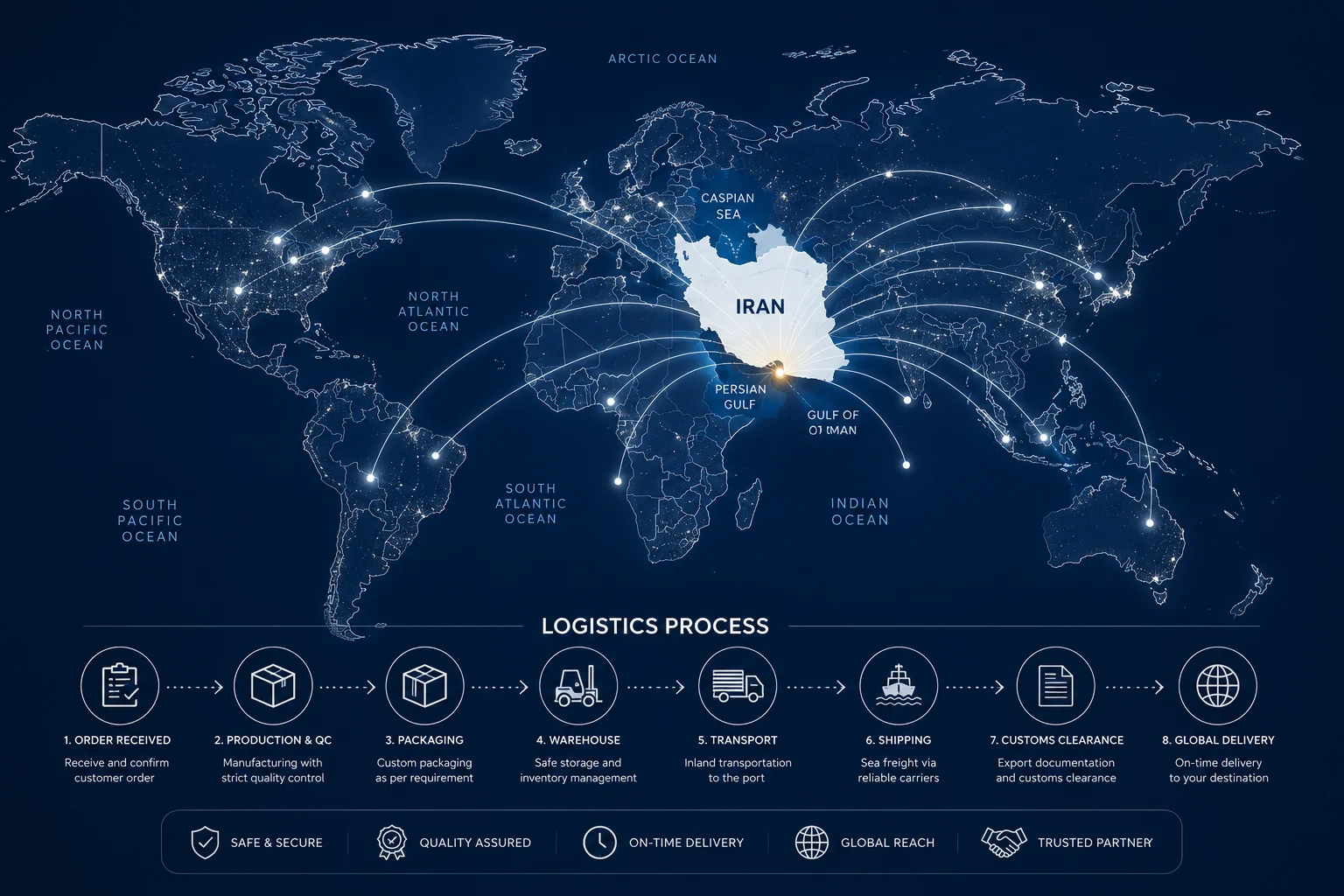
The large majority of Iranian rose water exported by sea moves through Bandar Abbas, Iran’s principal container port on the Persian Gulf, from which shipments reach Gulf destinations like the UAE and Saudi Arabia within days and can connect onward to more distant markets in Asia and Europe via transshipment hubs such as Jebel Ali in Dubai. Because Bandar Abbas and the surrounding Persian Gulf shipping lanes run through a hot climate for most of the year, temperature management during port-side handling and the initial sea leg is a genuine operational concern, not a formality. Buyers with a long transit ahead of them should specifically ask whether reefer, or temperature-controlled, container options are available for their route, particularly for shipments departing during warmer months.
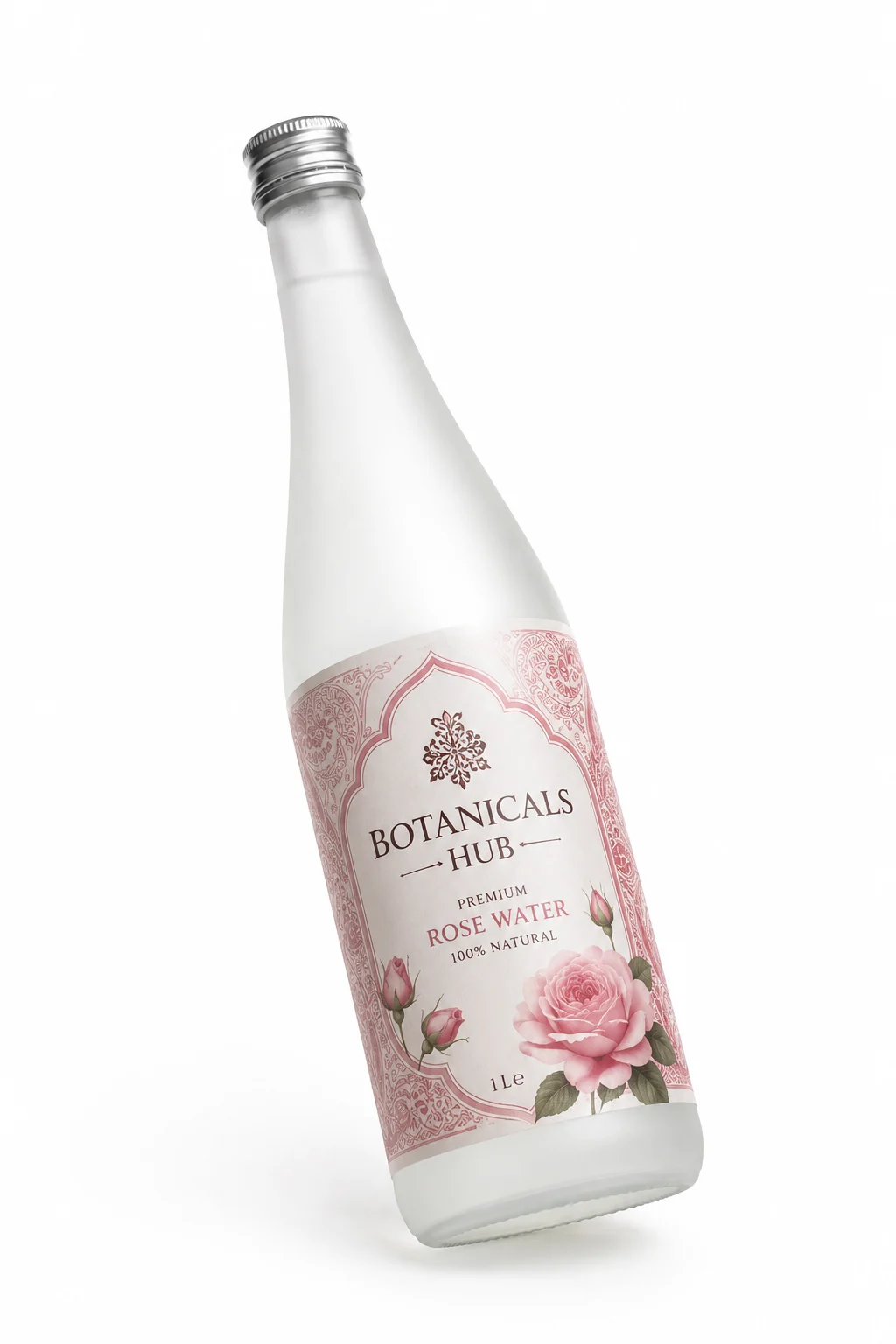
A one-liter bottle of Iranian Qamsar rose water in a champagne-style glass
Shipping Comparison Sea Freight (via Bandar Abbas) Air Freight
Typical use case Full container loads, recurring orders Samples, trial orders, urgent restocks
Approx. capacity, 20ft container ~80–100 drums (200L) or ~18–20 IBC totes (16,000–20,000 L) Not applicable at this scale
Approx. capacity, 40ft container ~160–180 drums (200L), roughly double the 20ft figure Not applicable at this scale
Speed to Gulf destinations Days Faster, but rarely cost-justified at this stage of the route
Cost per liter Lower Higher
Common Incoterms FOB, CIF EXW, FOB (airport)

Note that these container capacity figures are general industry rules of thumb for palletized 200-liter drums and standard IBC totes — actual loading depends on stacking method, pallet configuration, and the container’s maximum payload weight, since rose water’s density is close to that of plain water. Confirm exact loading plans with your freight forwarder for a specific order.

Air freight is commonly used for samples and smaller trial orders where speed matters more than per-unit shipping cost, letting a buyer evaluate a new supplier’s product before committing to a full container. For full container loads, sea freight through Bandar Abbas remains the standard, and the two Incoterms most commonly used are FOB, where the buyer arranges freight from the Iranian port onward, and CIF, where the supplier arranges freight and insurance through to the buyer’s port. First-time buyers often prefer CIF simply to reduce the number of new logistics relationships they need to manage on a first order.

Customs Documents

A typical import clearance for Iranian rose water requires a commercial invoice and packing list matched to the shipment, a Certificate of Origin, a phytosanitary certificate, the batch-specific Certificate of Analysis, a bill of lading or air waybill depending on shipping method, and — for cosmetic or food-destined shipments into regulated markets like the EU — the additional compliance documentation covered earlier (REACH support documents, Safety Data Sheet, and HACCP or equivalent food safety certification). Buyers should confirm the full document list with their customs broker for their specific destination before finalizing a purchase order, since requirements vary enough between markets that a document set that clears customs in one country can be incomplete for another.

Common Mistakes Buyers Make

The costliest mistakes in this trade tend to repeat across buyers, and most of them are avoidable with earlier questions rather than more expensive due diligence. Ordering a full container before testing a sample is the single most common one — pricing pressure or supplier urgency shouldn’t override the basic step of verifying a batch before scaling to it. Assuming a single global HS code or certification set applies everywhere is another, given how much classification and documentation requirements vary by destination. Treating “Damask rose” or “Product of Iran” as a sufficient quality guarantee, without requesting a batch-specific COA, leaves buyers exposed to the dilution and adulteration issues that are common enough in this category to actively test for. And underestimating the seasonality of supply — trying to negotiate volume and pricing outside the post-harvest window — routinely results in worse terms than buyers who plan their sourcing calendar around Iran’s spring harvest.

Before Your First Order: What to Request

Rather than moving straight to a purchase order, treat your first conversation with a supplier as a due-diligence checklist. Before committing to any volume, request:
A batch-specific Certificate of Analysis, covering pH, TDS, and additive disclosure.
A product sample, evaluated independently before any bulk commitment.
Full packaging specifications, including drum/tote lining material and UN-standard compliance.
Available Incoterms so that you can compare FOB and CIF costs for your route.
Lead time confirmation, from order placement to loading at Bandar Abbas.
Export references, if the supplier has worked with buyers in your target market before.
A supplier who answers all six without hesitation is worth moving forward with.
A supplier who resists two or more is worth pausing on, regardless of how competitive the quoted price looks.

Final Buying Checklist

Before finalizing a first order, confirm:

a batch-specific Certificate of Analysis covering pH, TDS, and additive disclosure.

Willingness from the supplier to accommodate independent third-party lab testing. 

A sample shipment evaluated before any bulk commitment. 

Clarity on distillation method — single or double — matched to your application. 

The correct HS code and required certifications for your specific destination market. 

Packaging format and Incoterm suited to your order size and logistics experience. 

Confirmed shelf life and storage guidance for the specific batch you’re purchasing. 

Awareness of Iran’s spring harvest timing if you’re negotiating an annual volume agreement.

Frequently Asked Questions

What is a reasonable minimum order quantity for a first rose water import order?
This varies by supplier, but many exporters can accommodate a smaller trial order, often a single drum, before requiring container-level commitments. It's worth asking specifically about first-order terms, which are frequently more flexible than standard published MOQs.
How can I tell if rose water has been diluted after distillation?
Independent pH and TDS lab testing are the fastest indicators, and GC-MS analysis offers the most definitive confirmation of authenticity for buyers who need it. Visual inspection alone cannot confirm dilution.
Is Iranian rose water the same as Bulgarian or Turkish rose water?
They generally come from the same Damask rose species, but climate, soil, and local distillation practices produce different aroma profiles. Buyers should request samples rather than assume interchangeability between origins.
Why does rose water pricing fluctuate more than other botanical exports?
Because it depends on a short, weather-sensitive annual harvest rather than continuous manufacturing, a stronger or weaker rose season directly affects available supply and price across the industry, not just for one supplier.
Do I need Halal certification even if my target market isn't primarily Muslim?
Not always, but it broadens resale options into Middle Eastern, North African, and Southeast Asian distribution channels at relatively low added cost in most cases.
Is single-distilled rose water lower quality than double-distilled?
Not inherently. Single-distilled is the standard for food and mainstream cosmetic use, while double-distilled is a refinement suited to premium formulations rather than a universal upgrade.
Is there an ISO standard specifically for rose water?
No. The relevant ISO document, ISO 9842, covers rose oil rather than rose water, and even that standard applies only to oil from Turkey, Morocco, and Bulgaria. Quality assurance in the rose water trade runs on supplier-level COAs and lab verification rather than a universal published standard.
Does Codex Alimentarius have a rose water standard?
No. Codex Alimentarius maintains international food standards broadly, but does not currently maintain one specific to rose water, leaving general food safety frameworks like HACCP as the applicable reference for food-grade buyers.
What's the difference between rose water and rose hydrosol?
In most of the trade, they refer to the same aqueous distillate. Where a distinction is drawn, "hydrosol" tends to signal cosmetic or aromatherapy marketing while "rose water" is used more broadly, but neither term guarantees a specific concentration without a COA.
Can I import rose water for cosmetic use into the EU without REACH registration?
No. REACH registration (Regulation (EC) 1907/2006) and CLP compliance (Regulation (EC) 1272/2008) apply to the ingredient itself for cosmetic-destined shipments into the EU, alongside compliance with Regulation (EC) 1223/2009 on cosmetic products.
What documentation should I request before wiring a deposit on a first order?
At minimum, a batch-specific COA, willingness to accommodate third-party testing, and a documented export history. Treat resistance to any of these as a reason to pause, not proceed.
How long does Iranian rose water typically take to reach a Gulf destination by sea?
Shipments to nearby Gulf destinations like the UAE and Saudi Arabia typically arrive within days via Bandar Abbas; more distant markets in Asia or Europe take longer and often route through a transshipment hub such as Jebel Ali.
Should I request a reefer container for my shipment?
It depends on your route and season. Given the hot climate along Persian Gulf shipping lanes for most of the year, buyers with longer transit times or shipments departing in warmer months should specifically ask their supplier whether temperature-controlled shipping is available or advisable.
Why do some suppliers quote significantly lower prices than others for what looks like the same product?
Unusually low pricing relative to the regional market is one of the more reliable signals of dilution or synthetic fragrance blending, not a genuine sourcing advantage. It's worth treating as a prompt for additional testing rather than a reason to order in bulk immediately.
Is private label or OEM the better route for a new cosmetic brand?
Private label suits buyers who want to launch under their own brand using a supplier's existing product and packaging capabilities. OEM suits buyers who need a custom formulation, concentration, or bottle design the supplier doesn't already produce as standard. OEM typically involves longer lead times and higher MOQs.
Does the HS code affect the duty rate I'll pay?
Yes, and it varies by country — rose water is classified under HTSUS 3301.90 in the United States but under HS 3303 in India, for example. Confirm the applicable code with your customs broker for your specific destination rather than assuming one code applies everywhere.
How many drums fit in a standard shipping container?
As a general rule of thumb, a 20-foot container holds roughly 80 to 100 200-liter drums (16,000–20,000 liters total), and a 40-foot container holds roughly 160 to 180 drums, though exact figures depend on the palletizing and stacking method. IBC totes of 1,000 liters typically load around 18 to 20 units per 20-foot container.
What's the biggest single quality risk in sourcing rose water internationally?
Adulteration through post-distillation dilution or synthetic fragrance blending, since it isn't reliably detectable by smell or appearance and requires lab testing to rule it out.
Is it possible to source from multiple Iranian regions to reduce supply risk?
لورم ایپسوم متن ساختگی با تولید سادگی نامفهوم از صنعت چاپ و با استفاده از طراحان گرافیک است. چاپگرها و متون بلکه روزنامه و مجله در ستون و سطرآنچنان که لازم است و برای شرایط فعلی تکنولوژی مورد نیاز و کاربردهای متنوع با هدف بهبود ابزارهای کاربردی می باشد.
Is it possible to source from multiple Iranian regions to reduce supply risk?
Yes. Sourcing across both Kashan and Khorasan, for example, is a practical way to reduce exposure to a single region's harvest outcome in any given year, since growing conditions differ enough between the two that a weak season in one doesn't necessarily affect the other.
What's a realistic timeline from first inquiry to first shipment for a new buyer?
This depends heavily on the specific certifications required and whether a sample evaluation precedes the bulk order, but buyers should plan for sample testing, documentation review, and production or stock allocation to take meaningfully longer than a single commodity purchase, particularly for a first-time relationship with a new supplier.

Conclusion

Sourcing Iranian rose water rewards buyers who treat it as an agricultural, seasonal ingredient rather than a standardized manufactured product. The absence of a universal quality standard specific to rose water means the real quality control happens at the supplier-verification stage — batch-specific testing, transparent process disclosure, and sample evaluation before scale. Buyers who build their sourcing calendar around Iran’s spring harvest, confirm the right HS code and certification set for their specific destination, and insist on independent lab verification consistently avoid the costliest mistakes in this trade.

Request a Sample

Evaluate a batch before committing to volume. Request a Certificate of Analysis and a trial shipment to test concentration, aroma, and consistency against your specification before scaling to a full order.

Request a Wholesale Quotation

Ready to discuss volume, packaging format, and Incoterms for your target market? Request a wholesale quotation and our export team will confirm certification, lead time, and shipping options for your destination.

Resources

  1. Iran’s National Union of Rose Water and Herbal Distillates Producers (as reported by Iranian trade media) — export destinations, regional production volume, and market trends

  2. ISO 9842:2024, “Essential oil of rose (Rosa x damascena Miller),” International Organization for Standardization

  3. CBI (Centre for the Promotion of Imports from Developing Countries) — market and market-entry information on essential oils and natural ingredients for cosmetics and food and drinks in the European market

  4. European Commission — Regulation (EC) No 1223/2009 on cosmetic products, Regulation (EC) No 1907/2006 (REACH), and Regulation (EC) No 1272/2008 (CLP)

  5. United States Customs and Border Protection — tariff classification ruling on bottled rose water under HTSUS 3301.90

  6. Indian customs tariff schedule records — classification of rose water under HS 3303

  7. Codex Alimentarius Commission — general food safety standards framework (no rose water-specific standard currently maintained)

  8. Academic and industry research on Damask rose cultivation, distillation yield, and aromatic compound composition in Iran, published via peer-reviewed agricultural and essential-oil research channels.

  9. Standard container and drum loading references from international freight and logistics industry sources

Sourcing rose water for wholesale distribution, private label, or manufacturing input means navigating a supply chain that looks nothing like sourcing a standardized commodity. Rose water is agricultural, seasonal, easy to dilute without visual detection, and inconsistently classified across customs regimes. This guide is built for the buyer’s side of that equation: what to specify, what to verify, what documentation to request, and where deals with Iranian suppliers typically go wrong.

Why Iran Produces the World's Most Famous Rose Water

Iran’s rose water production traces back over a thousand years, with distillation methods documented as far back as the physician-scientist Avicenna, and commercial distilleries recorded operating in Shiraz as early as the seventeenth century. That history matters less as a marketing point and more because it explains why Iran’s rose water infrastructure — from cultivar selection to distillery design — is more mature and specialized than in most producing countries.

That maturity shows up in trade volume. According to Iran’s National Union of Rose Water and Herbal Distillates Producers, Iranian rose water reaches roughly thirty export markets, led by Saudi Arabia, the UAE, and Bahrain. The UAE plays an outsized role in this trade as a re-export hub: it imports Iranian rose water in bulk, repackages it, and re-exports it onward to other markets, which is part of why UAE trade statistics for rose water don’t reflect true end-market consumption. Demand outside the Gulf has also been expanding, with China and South Korea importing increasing volumes for spa and wellness applications, and Germany importing for food industry use.

For a buyer evaluating Iran as a source, the practical takeaway is that Iranian producers are set up for export at scale, with established documentation processes and freight routes — this is not a market where you’re the first international buyer a distillery has worked with.

What Makes Iranian Rose Water Different

Iranian rose water is not produced in one uniform location. Two regions account for the large majority of commercial-grade output, and they aren’t identical products.

Qamsar, in Kashan County, Isfahan Province, is the historic center of the industry and remains where the largest volume of commercial distillation happens. Industry estimates place Kashan’s annual output in the range of 30,000 to 33,000 tons of rose water, with field yields of roughly two to seven tons of rose petals per hectare depending on seasonal conditions.

Farrokhad, in Khorasan, has grown into a significant secondary production region. Khorasan’s climate differs meaningfully from Isfahan Province — cooler nights and a slightly later bloom window — and producers in the region generally describe Farrokhad rose water as having a somewhat different aromatic character than Qamsar’s, though both come from the same Damask rose species. For a buyer, sourcing across both regions is a practical way to diversify supply risk: a weak harvest year in one province doesn’t automatically mean a weak year in the other, which matters for anyone locking in annual volume commitments.

It’s also worth being precise about what “Damask rose” does and doesn’t guarantee. Rosa damascena is the same species grown in Bulgaria’s Rose Valley and in Turkey for the global perfumery trade, but climate, soil, and distillation practice produce distinctly different aroma profiles between Iranian, Bulgarian, and Turkish output. Species alone is not a quality claim — it’s a starting point that still needs to be backed by lab verification.

Global Rose Water Market Overview

Market research estimates for the global rose water market cluster in a fairly consistent range: roughly $475 to $540 million in current value, with most forecasts projecting growth to somewhere between $970 million and just over $1 billion by the early 2030s, at a compound annual growth rate around 7%. Buyers should treat any single figure in this space with some caution — market research vendors disagree with each other by wide margins on the broader “floral water” category that includes other hydrosols, with estimates for that larger category ranging anywhere from roughly $2.5 billion to $20 billion depending on the research firm and how they define the category. Directionally, the signal is consistent growth driven by clean-label cosmetics demand and food and beverage use; the exact market-cap figure is less reliable than the trend itself.

On the European side, the European Commission-regulated cosmetics and natural ingredients market that rose water competes and travels alongside is described by CBI, the Netherlands-based trade promotion body for exporters from developing countries, as a market where demand for essential oils and natural distillates is expected to roughly double over a six-year horizon, driven largely by clean-label demand in cosmetics. The top importing countries for essential oils and related natural distillates into Europe are France, Germany, the UK, the Netherlands, Switzerland, and Spain — with the Netherlands and Switzerland functioning primarily as trading and distribution hubs rather than end-consumption markets, similar in structure to the UAE’s role in the Gulf.

Types of Rose Water

Type Process Aroma Profile Typical Use
Single-distilled Direct byproduct of one steam distillation pass Full-bodied, characteristic rose aroma Food, beverage, mainstream cosmetics
Double-distilled Redistilled a second time Lighter, more refined, less residual plant material Premium cosmetic formulations
Compound/blended Rose water combined with other botanicals or additives Varies by formulation Custom OEM products, specialty retail

There’s also a terminology point worth clarifying before writing a purchase order: “rose water” and “rose hydrosol” are used interchangeably throughout most of the trade to describe the same aqueous distillate. Where a distinction is drawn, “hydrosol” tends to signal a product marketed toward cosmetic or aromatherapy buyers as a minimally processed distillate, while “rose water” is used more broadly across food and general commercial contexts. This is a marketing convention rather than a regulated technical distinction, so neither term on its own guarantees a specific concentration — that has to come from a Certificate of Analysis.

Food Grade vs Cosmetic Grade

Primary concern Additive-free composition, ingestible safety Aroma refinement, dermal safety
Common distillation Single-distilled Often double-distilled
Core certification HACCP or ISO 22000 Safety Data Sheet, REACH (EU-bound)
Regulatory anchor National food safety codes EU Regulation (EC) 1223/2009 (if EU-bound)
Typical buyer Food & beverage manufacturers, importers Cosmetics brands, formulators

The distinction isn’t primarily about the distillation process — it’s about documentation, additive tolerance, and testing focus. Additives like glycerin or synthetic fragrance, even in small amounts, are typically disqualifying for food-grade use unless explicitly disclosed and permitted under the destination market’s food regulations. Cosmetic-grade shipments into the EU specifically need to align with Regulation (EC) 1223/2009 on cosmetic products, Regulation (EC) 1907/2006 (REACH), and Regulation (EC) 1272/2008 (CLP) for the raw ingredient itself. These aren’t Iran-specific requirements; they apply to any natural ingredient entering the EU cosmetics supply chain, but they’re frequently the point where first-time Iranian-supplier relationships stall, simply because the requirement isn’t raised until late in the process.

How Rose Water Is Produced

Iranian producers use both traditional and industrial steam distillation methods, and the difference matters for consistency, not just scale. In traditional operations, petals are boiled directly in the still together with water. In industrial distilleries, steam is passed through the petals rather than boiling them directly — a gentler process generally considered better at preserving the more volatile aromatic compounds. Buyers sourcing for premium cosmetic applications should specifically ask which method a given supplier uses, since it affects both aroma quality and batch-to-batch consistency.

Damask Rose Harvest

a woman worker picking damasc rose in a iranian farm

Rose harvest in Iran runs for a short window each spring, and timing within that window is one of the biggest levers on final product quality. Picking is done in the early morning hours, while petals still hold their highest concentration of aromatic compounds, before the day’s heat begins degrading them. Petals that sit too long after picking before reaching the still lose aromatic quality to microbial activity, which is why serious producers move petals from field to still within hours, not days.

For a buyer, this narrow window is the reason rose water supply is fundamentally seasonal rather than continuous. Annual contracts should be structured around a single harvest period, and buyers negotiating volume commitments are generally better served locking in pricing shortly after harvest, while supply is at its fullest, rather than waiting until later in the year when available stock — and negotiating leverage — both narrow.

Distillation Process and Yield

A commonly cited figure for the traditional Iranian process is a yield of roughly two to three kilograms of rose water for every kilogram of fresh petals used. Combined with field yields of two to seven tons of petals per hectare, this ratio is what ultimately sets the ceiling on how much verified, high-quality rose water is available in a given year — worth understanding before negotiating long-term volume commitments with any single supplier.

A rose water production line operator adjusts the pressure of distillation boilers at a rose water factory in Iran.
Distillation Comparison Traditional (Direct Boil) Industrial (Steam-Passed)
Method Petals boiled directly with water Steam passed through petals
Aromatic compound preservation Moderate Generally higher
Scale Smaller batches Larger, more consistent batches
Typical buyer fit Artisanal / small private label Bulk wholesale, larger private label runs

Chemical Composition

Genuine Damask rose water’s aromatic character comes from a specific set of volatile compounds — primarily citronellol, geraniol, and phenylethanol, along with smaller quantities of nerol and other terpene alcohols. These compounds are what gas chromatography-mass spectrometry (GC-MS) analysis looks for when verifying authenticity: a genuine distillate shows a consistent, recognizable compound profile, while a diluted or synthetically enhanced product typically shows an off-profile that a qualified lab can flag even when the product smells convincing to a non-specialist.

Beyond aromatic compounds, two simpler and faster tests give buyers a practical first screen: pH, which falls within a narrow, testable range for genuine Damask rose water and is one of the fastest ways to flag dilution, and Total Dissolved Solids (TDS), which reflects concentration and helps catch inconsistency between batches from the same supplier. Rose water is, by composition, over 99% water, with a density close to 0.99–1.00 g/mL — close enough to plain water that weight-based freight calculations should use this figure rather than assuming a lighter aromatic liquid.

Quality Standards

It’s worth being direct about a gap in this industry: there is no ISO standard written specifically for rose water. The relevant ISO document, ISO 9842, covers rose oil — the essential oil, not the aqueous distillate — and even that standard, in its current 2024 edition, specifies characteristics for rose oil cultivated in Turkey, Morocco, and Bulgaria specifically. It does not cover Iranian-origin rose oil or rose water at all.

Standard / Body What It Covers Relevance to Rose Water
ISO 9842:2024 Rose oil (Turkey, Morocco, Bulgaria) Adjacent, not directly applicable to Iranian rose water
EU Regulation (EC) 1223/2009 Cosmetic products placed on the EU market Applies if rose water is sold into EU cosmetic channels
EU Regulation (EC) 1907/2006 (REACH) Chemical/ingredient registration in the EU Applies to the raw ingredient for EU-bound shipments
EU Regulation (EC) 1272/2008 (CLP) Classification, labelling, packaging Applies to EU-bound shipments
HACCP / ISO 22000 Food safety management at the production facility Expected by most food-grade buyers

In practice, this means quality assurance in the Iranian rose water trade runs almost entirely on the strength of each individual supplier’s Certificate of Analysis and their willingness to submit to independent lab testing, rather than on a universal published standard a buyer can simply cite in a contract. That makes supplier vetting more important in this category than in commodities where an ISO or Codex standard does the verification work for you — worth noting that Codex Alimentarius, the body that does set international food standards, does not currently maintain a rose water-specific standard either, leaving general food safety codes (like HACCP) as the applicable framework instead.

International Certifications

Certification / Document Who Typically Requires It
Certificate of Analysis (batch-specific) All serious buyers
Phytosanitary certificate Most import jurisdictions, agricultural-derived goods
Halal certification Middle East, North Africa, Southeast Asia resale channels
HACCP / ISO 22000 Food & beverage buyers
Certificate of Origin Customs clearance in most markets
Safety Data Sheet Cosmetic and industrial buyers
REACH / CLP documentation EU-bound cosmetic shipments

Ask early in supplier conversations which of these are issued as standard practice versus which require advance notice — this directly affects lead-time planning on a first order.

HS Code and Customs Classification

Rose water’s customs classification is one of the more commonly misunderstood details in this trade, because it isn’t classified identically everywhere. In the United States, a formal Customs and Border Protection ruling classified bottled rose water under HTSUS 3301.90 — the “aqueous distillates and aqueous solutions of essential oils” subheading — rather than under perfumes. In India, by contrast, rose water is classified under HS 3303, within the perfumes and toilet waters heading. This distinction affects duty rates and documentation requirements for what is physically the same product, so buyers should confirm the correct classification with their own customs broker for their specific destination market rather than assuming a single global code applies.

Export Requirements

Shipments into the EU need to satisfy REACH and CLP requirements at the ingredient level if they’re destined for cosmetic use, in addition to standard food-safety documentation if destined for food use — these are EU-wide requirements, not Iran-specific hurdles, but they’re commonly where a first shipment gets delayed simply because the paperwork wasn’t requested from the supplier early enough. Packaging for international shipment should meet UN-standard specifications for drums and jerry cans used in cross-border trade, which most established Iranian exporters already default to, but it’s worth confirming rather than assuming on a first order.

Packaging Options

Rose water cartons in custom packaging in the warehouse of a rose water factory
Format Volume Best For Approx. Weight (Full)
Food-grade drum 25 L Small trial orders, sampling ~25 kg
Food-grade drum 200 L Standard wholesale orders ~200 kg
IBC tote 1,000 L High-volume, recurring contracts ~1,000 kg
Glass bottle 250 ml – 1 L Finished, retail-ready / private label Varies by format

Buyers should confirm that drum or tote linings are food-grade and chemically compatible with rose water for the full duration of shipping, and that packaging meets UN-standard specifications where required by the destination market. Suppliers offering direct private-label bottling can meaningfully reduce a buyer’s own repackaging logistics.

Shelf Life

Properly distilled and packaged rose water typically holds for eighteen to twenty-four months. The main variables affecting that window are the concentration and purity of the batch, whether any preservative was used, and how consistently it was kept below temperature thresholds that accelerate aroma degradation during both storage and transit. Buyers should ask suppliers for the expected shelf life of the specific batch being purchased, not a generic industry figure, since concentration and preservative use both shift the number meaningfully.

Storage Conditions

Rose water should be kept cool, dark, and away from temperature fluctuation. As a general guideline, standard storage in the range of 15–25°C (59–77°F) supports the typical 18–24 month shelf life, while refrigerated storage around 4–10°C is commonly recommended by hydrosol producers for buyers looking to extend freshness beyond that standard window. Direct sunlight and heat cycling are the two most common causes of premature aroma loss, and both are more of a risk during shipping and warehousing than during final retail storage. Buyers importing into regions with long inland transit after the port of arrival should ask specifically about temperature exposure during that leg, not just the sea voyage.

Choosing a Reliable Supplier

A reliable supplier should be able to provide, without hesitation: a batch-specific Certificate of Analysis and a willingness to accommodate independent third-party lab testing; clear, specific answers about distillation method and concentration ratio rather than vague marketing language; sample availability before any bulk commitment; a documented export history and, where reasonable, references from prior buyers; and transparent packaging and Incoterm options rather than a single take-it-or-leave-it format.

Vague answers, resistance to third-party verification, or pressure to skip sampling are the clearest warning signs in this trade. Given that no universal ISO or Codex standard governs rose water quality, supplier-level verification is effectively the industry’s real quality control mechanism — treat it accordingly rather than as an optional extra step.

Private Label Opportunities

Many established Iranian rose water exporters offer private-label bottling — supplying rose water under a buyer’s own brand and packaging rather than in generic bulk drums. This suits buyers who already have a defined product concept and want to launch under their own brand without managing a separate repackaging step. Minimum order quantities for private-label runs are typically higher than for bulk-drum orders, since label design and bottle setup carry fixed costs regardless of volume, but for a brand-building strategy the convenience and finished presentation often justify the higher entry point.

let's grow together

You focus on your market. We handle production, packaging, and private labeling.

OEM Manufacturing

OEM manufacturing is a step beyond private label: rather than simply rebranding an existing product, the buyer specifies a custom formulation, concentration, blend, or bottle design that the supplier produces to order. This route makes sense for buyers developing a differentiated product — a rose water blended with a specific complementary botanical, a nonstandard concentration for a niche cosmetic application, or packaging designed to a specific brand’s technical spec rather than a supplier’s standard catalog. OEM arrangements typically involve longer lead times and higher MOQs than either bulk or private-label orders, since they require the supplier to adjust production rather than draw from standard stock.

Pricing Factors

Because rose water is tied to an agricultural harvest rather than continuous manufacturing, its pricing behaves differently from a standard manufactured commodity. The variables that move price most are the strength of that year’s harvest, since a weaker season tightens supply industry-wide; the distillation depth requested, with double-distilled product commanding a clear premium; the concentration level specified in the purchase order, since a stricter minimum concentration costs more than standard commercial dilution; the packaging format, with bulk drums considerably cheaper per liter than retail-ready or private-label bottling; and any additional certification requirements, since extra lab testing, Halal certification, or EU compliance documentation adds both cost and lead time. Buyers negotiating annual supply agreements are generally better served locking in volume and pricing shortly after harvest rather than later in the year, when both available stock and negotiating leverage narrow.

Shipping Methods

Iranian rose water reaches international buyers by sea and, for smaller or time-sensitive orders, by air. The right choice depends less on cost alone and more on order size, shelf-life margin, and how much of that shelf life is already used up by the time product reaches the port.

Sea Freight vs Air Freight

The large majority of Iranian rose water exported by sea moves through Bandar Abbas, Iran’s principal container port on the Persian Gulf, from which shipments reach Gulf destinations like the UAE and Saudi Arabia within days and can connect onward to more distant markets in Asia and Europe via transshipment hubs such as Jebel Ali in Dubai. Because Bandar Abbas and the surrounding Persian Gulf shipping lanes run through a hot climate for most of the year, temperature management during port-side handling and the initial sea leg is a genuine operational concern, not a formality. Buyers with a long transit ahead of them should specifically ask whether reefer, or temperature-controlled, container options are available for their route, particularly for shipments departing during warmer months.

A one-liter bottle of Iranian Qamsar rose water in a champagne-style glass
Shipping Comparison Sea Freight (via Bandar Abbas) Air Freight
Typical use case Full container loads, recurring orders Samples, trial orders, urgent restocks
Approx. capacity, 20ft container ~80–100 drums (200L) or ~18–20 IBC totes (16,000–20,000 L) Not applicable at this scale
Approx. capacity, 40ft container ~160–180 drums (200L), roughly double the 20ft figure Not applicable at this scale
Speed to Gulf destinations Days Faster, but rarely cost-justified at this stage of the route
Cost per liter Lower Higher
Common Incoterms FOB, CIF EXW, FOB (airport)

Note that these container capacity figures are general industry rules of thumb for palletized 200-liter drums and standard IBC totes — actual loading depends on stacking method, pallet configuration, and the container’s maximum payload weight, since rose water’s density is close to that of plain water. Confirm exact loading plans with your freight forwarder for a specific order.

Air freight is commonly used for samples and smaller trial orders where speed matters more than per-unit shipping cost, letting a buyer evaluate a new supplier’s product before committing to a full container. For full container loads, sea freight through Bandar Abbas remains the standard, and the two Incoterms most commonly used are FOB, where the buyer arranges freight from the Iranian port onward, and CIF, where the supplier arranges freight and insurance through to the buyer’s port. First-time buyers often prefer CIF simply to reduce the number of new logistics relationships they need to manage on a first order.

Customs Documents

A typical import clearance for Iranian rose water requires a commercial invoice and packing list matched to the shipment, a Certificate of Origin, a phytosanitary certificate, the batch-specific Certificate of Analysis, a bill of lading or air waybill depending on shipping method, and — for cosmetic or food-destined shipments into regulated markets like the EU — the additional compliance documentation covered earlier (REACH support documents, Safety Data Sheet, and HACCP or equivalent food safety certification). Buyers should confirm the full document list with their customs broker for their specific destination before finalizing a purchase order, since requirements vary enough between markets that a document set that clears customs in one country can be incomplete for another.

Common Mistakes Buyers Make

The costliest mistakes in this trade tend to repeat across buyers, and most of them are avoidable with earlier questions rather than more expensive due diligence. Ordering a full container before testing a sample is the single most common one — pricing pressure or supplier urgency shouldn’t override the basic step of verifying a batch before scaling to it. Assuming a single global HS code or certification set applies everywhere is another, given how much classification and documentation requirements vary by destination. Treating “Damask rose” or “Product of Iran” as a sufficient quality guarantee, without requesting a batch-specific COA, leaves buyers exposed to the dilution and adulteration issues that are common enough in this category to actively test for. And underestimating the seasonality of supply — trying to negotiate volume and pricing outside the post-harvest window — routinely results in worse terms than buyers who plan their sourcing calendar around Iran’s spring harvest.

Before Your First Order: What to Request

Rather than moving straight to a purchase order, treat your first conversation with a supplier as a due-diligence checklist. Before committing to any volume, request:
A batch-specific Certificate of Analysis, covering pH, TDS, and additive disclosure.
A product sample, evaluated independently before any bulk commitment.
Full packaging specifications, including drum/tote lining material and UN-standard compliance.
Available Incoterms so that you can compare FOB and CIF costs for your route.
Lead time confirmation, from order placement to loading at Bandar Abbas.
Export references, if the supplier has worked with buyers in your target market before.
A supplier who answers all six without hesitation is worth moving forward with.
A supplier who resists two or more is worth pausing on, regardless of how competitive the quoted price looks.

Final Buying Checklist

Before finalizing a first order, confirm:

a batch-specific Certificate of Analysis covering pH, TDS, and additive disclosure.

Willingness from the supplier to accommodate independent third-party lab testing. 

A sample shipment evaluated before any bulk commitment. 

Clarity on distillation method — single or double — matched to your application. 

The correct HS code and required certifications for your specific destination market. 

Packaging format and Incoterm suited to your order size and logistics experience. 

Confirmed shelf life and storage guidance for the specific batch you’re purchasing. 

Awareness of Iran’s spring harvest timing if you’re negotiating an annual volume agreement.

Frequently Asked Questions

What is a reasonable minimum order quantity for a first rose water import order?
This varies by supplier, but many exporters can accommodate a smaller trial order, often a single drum, before requiring container-level commitments. It's worth asking specifically about first-order terms, which are frequently more flexible than standard published MOQs.
How can I tell if rose water has been diluted after distillation?
Independent pH and TDS lab testing are the fastest indicators, and GC-MS analysis offers the most definitive confirmation of authenticity for buyers who need it. Visual inspection alone cannot confirm dilution.
Is Iranian rose water the same as Bulgarian or Turkish rose water?
They generally come from the same Damask rose species, but climate, soil, and local distillation practices produce different aroma profiles. Buyers should request samples rather than assume interchangeability between origins.
Why does rose water pricing fluctuate more than other botanical exports?
Because it depends on a short, weather-sensitive annual harvest rather than continuous manufacturing, a stronger or weaker rose season directly affects available supply and price across the industry, not just for one supplier.
Do I need Halal certification even if my target market isn't primarily Muslim?
Not always, but it broadens resale options into Middle Eastern, North African, and Southeast Asian distribution channels at relatively low added cost in most cases.
Is single-distilled rose water lower quality than double-distilled?
Not inherently. Single-distilled is the standard for food and mainstream cosmetic use, while double-distilled is a refinement suited to premium formulations rather than a universal upgrade.
Is there an ISO standard specifically for rose water?
No. The relevant ISO document, ISO 9842, covers rose oil rather than rose water, and even that standard applies only to oil from Turkey, Morocco, and Bulgaria. Quality assurance in the rose water trade runs on supplier-level COAs and lab verification rather than a universal published standard.
Does Codex Alimentarius have a rose water standard?
No. Codex Alimentarius maintains international food standards broadly, but does not currently maintain one specific to rose water, leaving general food safety frameworks like HACCP as the applicable reference for food-grade buyers.
What's the difference between rose water and rose hydrosol?
In most of the trade, they refer to the same aqueous distillate. Where a distinction is drawn, "hydrosol" tends to signal cosmetic or aromatherapy marketing while "rose water" is used more broadly, but neither term guarantees a specific concentration without a COA.
Can I import rose water for cosmetic use into the EU without REACH registration?
No. REACH registration (Regulation (EC) 1907/2006) and CLP compliance (Regulation (EC) 1272/2008) apply to the ingredient itself for cosmetic-destined shipments into the EU, alongside compliance with Regulation (EC) 1223/2009 on cosmetic products.
What documentation should I request before wiring a deposit on a first order?
At minimum, a batch-specific COA, willingness to accommodate third-party testing, and a documented export history. Treat resistance to any of these as a reason to pause, not proceed.
How long does Iranian rose water typically take to reach a Gulf destination by sea?
Shipments to nearby Gulf destinations like the UAE and Saudi Arabia typically arrive within days via Bandar Abbas; more distant markets in Asia or Europe take longer and often route through a transshipment hub such as Jebel Ali.
Should I request a reefer container for my shipment?
It depends on your route and season. Given the hot climate along Persian Gulf shipping lanes for most of the year, buyers with longer transit times or shipments departing in warmer months should specifically ask their supplier whether temperature-controlled shipping is available or advisable.
Why do some suppliers quote significantly lower prices than others for what looks like the same product?
Unusually low pricing relative to the regional market is one of the more reliable signals of dilution or synthetic fragrance blending, not a genuine sourcing advantage. It's worth treating as a prompt for additional testing rather than a reason to order in bulk immediately.
Is private label or OEM the better route for a new cosmetic brand?
Private label suits buyers who want to launch under their own brand using a supplier's existing product and packaging capabilities. OEM suits buyers who need a custom formulation, concentration, or bottle design the supplier doesn't already produce as standard. OEM typically involves longer lead times and higher MOQs.
Does the HS code affect the duty rate I'll pay?
Yes, and it varies by country — rose water is classified under HTSUS 3301.90 in the United States but under HS 3303 in India, for example. Confirm the applicable code with your customs broker for your specific destination rather than assuming one code applies everywhere.
How many drums fit in a standard shipping container?
As a general rule of thumb, a 20-foot container holds roughly 80 to 100 200-liter drums (16,000–20,000 liters total), and a 40-foot container holds roughly 160 to 180 drums, though exact figures depend on the palletizing and stacking method. IBC totes of 1,000 liters typically load around 18 to 20 units per 20-foot container.
What's the biggest single quality risk in sourcing rose water internationally?
Adulteration through post-distillation dilution or synthetic fragrance blending, since it isn't reliably detectable by smell or appearance and requires lab testing to rule it out.
Is it possible to source from multiple Iranian regions to reduce supply risk?
لورم ایپسوم متن ساختگی با تولید سادگی نامفهوم از صنعت چاپ و با استفاده از طراحان گرافیک است. چاپگرها و متون بلکه روزنامه و مجله در ستون و سطرآنچنان که لازم است و برای شرایط فعلی تکنولوژی مورد نیاز و کاربردهای متنوع با هدف بهبود ابزارهای کاربردی می باشد.
Is it possible to source from multiple Iranian regions to reduce supply risk?
Yes. Sourcing across both Kashan and Khorasan, for example, is a practical way to reduce exposure to a single region's harvest outcome in any given year, since growing conditions differ enough between the two that a weak season in one doesn't necessarily affect the other.
What's a realistic timeline from first inquiry to first shipment for a new buyer?
This depends heavily on the specific certifications required and whether a sample evaluation precedes the bulk order, but buyers should plan for sample testing, documentation review, and production or stock allocation to take meaningfully longer than a single commodity purchase, particularly for a first-time relationship with a new supplier.

Conclusion

Sourcing Iranian rose water rewards buyers who treat it as an agricultural, seasonal ingredient rather than a standardized manufactured product. The absence of a universal quality standard specific to rose water means the real quality control happens at the supplier-verification stage — batch-specific testing, transparent process disclosure, and sample evaluation before scale. Buyers who build their sourcing calendar around Iran’s spring harvest, confirm the right HS code and certification set for their specific destination, and insist on independent lab verification consistently avoid the costliest mistakes in this trade.

Request a Sample

Evaluate a batch before committing to volume. Request a Certificate of Analysis and a trial shipment to test concentration, aroma, and consistency against your specification before scaling to a full order.

Request a Wholesale Quotation

Ready to discuss volume, packaging format, and Incoterms for your target market? Request a wholesale quotation and our export team will confirm certification, lead time, and shipping options for your destination.

Resources

  1. Iran’s National Union of Rose Water and Herbal Distillates Producers (as reported by Iranian trade media) — export destinations, regional production volume, and market trends

  2. ISO 9842:2024, “Essential oil of rose (Rosa x damascena Miller),” International Organization for Standardization

  3. CBI (Centre for the Promotion of Imports from Developing Countries) — market and market-entry information on essential oils and natural ingredients for cosmetics and food and drinks in the European market

  4. European Commission — Regulation (EC) No 1223/2009 on cosmetic products, Regulation (EC) No 1907/2006 (REACH), and Regulation (EC) No 1272/2008 (CLP)

  5. United States Customs and Border Protection — tariff classification ruling on bottled rose water under HTSUS 3301.90

  6. Indian customs tariff schedule records — classification of rose water under HS 3303

  7. Codex Alimentarius Commission — general food safety standards framework (no rose water-specific standard currently maintained)

  8. Academic and industry research on Damask rose cultivation, distillation yield, and aromatic compound composition in Iran, published via peer-reviewed agricultural and essential-oil research channels.

  9. Standard container and drum loading references from international freight and logistics industry sources